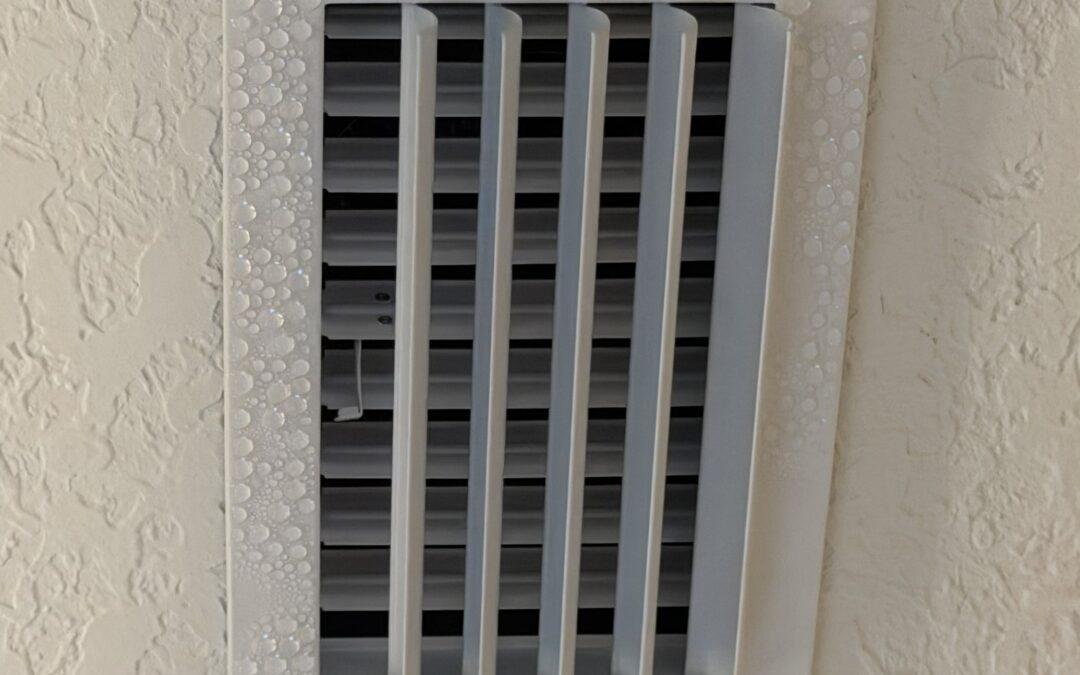
If you’ve noticed water dripping from an AC vent, beading on a supply register, or a damp ring forming on the ceiling around your ductwork, you’re not imagining things — and it’s not a random plumbing mystery. It’s condensation, and in Clearwater’s climate, it’s one of the clearest early-warning signs a home can give you about excess humidity.
This guide breaks down the actual building science behind sweating vents: why it happens, what it means for microbial growth risk in your home, and what you can do about it.
The Core Science: Dew Point, Air Temperature, and Metal Surfaces
Every pocket of air holds a certain amount of moisture, and that moisture has a threshold called the dew point — the exact temperature at which air becomes fully saturated and can no longer hold its water vapor as gas. Once a surface drops below that dew point, moisture in the air condenses into liquid water on contact.
Three variables determine whether this happens at your vents:
1. Supply air temperature — Air moving through your ductwork is typically 55–65°F, straight off the evaporator coil.
2. Metal surface temperature — Your vent, register, and duct boot cool to match the air passing across them.
3. Room dew point — Directly tied to your indoor relative humidity (RH). The higher your indoor RH, the higher your dew point.
When the room’s dew point rises above the temperature of the metal vent, condensation is a physical certainty — not a maintenance defect. This is the exact same principle behind a cold glass of iced tea “sweating” on a humid Florida afternoon. The glass isn’t leaking; the surrounding air is depositing its excess moisture onto a cold surface.
The Clearwater Factor: Why This Is So Common Here
Clearwater’s Gulf Coast climate creates near-ideal conditions for vent sweating for most of the year. Average outdoor humidity routinely pushes indoor relative humidity into the 55– 59% range during summer months, even in homes with a well-functioning HVAC system. Ideal indoor RH for comfort and moisture control is 45–55% — meaning many area homes are already running above the safe zone before any other contributing factor is considered.
The Thermostat “Goldilocks Zone”: 74–78°F
One of the most common causes of vent sweating we see in this area is a thermostat set below 74°F. Here’s why that matters:
Your air conditioner only removes moisture from the air while it’s actively running (this is called latent heat removal). When a thermostat is set very low, the system cools the space quickly, satisfies the setpoint, and shuts off — meaning shorter runtimes and less total dehumidification, even though the air feels cold. At the same time, a lower setpoint keeps supply air and duct metal colder, narrowing the gap between the metal’s temperature and the room’s dew point.
Staying in the 74–78°F range typically allows a system to run long enough to manage both temperature and humidity together — which is the actual job an air conditioner is designed to do.
Doors, Windows, and Humidity Infiltration
Every time a door or window is opened while the AC is running, warm, moisture-laden outdoor air is introduced directly into the conditioned space. In a coastal climate like Clearwater’s, this can spike indoor dew point in a matter of minutes, dramatically increasing the odds of condensation forming at any cold surface in the home — vents included.
Attic and Crawlspace Air Gaps
Unsealed penetrations around ductwork, attic access hatches, and crawlspace openings act as continuous, low-level entry points for humid outdoor air — even when doors and windows stay shut. Because these gaps often go unnoticed, they can quietly sustain elevated indoor humidity levels around the clock, undermining even a well-run HVAC system.
Why Sweating Vents Matter More Than the Water Itself
It’s tempting to treat a sweating vent as a simple nuisance — wipe up the water, maybe wrap the vent boot in insulation, and move on. But from a building science standpoint, a sweating vent is a symptom, not the underlying problem. The real story is what that condensation indicates about the rest of the home:
- Microbial growth risk: Microbial growth require three things to establish and spread — moisture, an organic food source (drywall paper, dust, insulation), and time. A visibly sweating vent means those conditions likely exist in less visible places too: inside wall cavities, above ceiling tiles, inside the duct system itself, and in attic or crawlspace assemblies where temperature and moisture patterns mirror what’s happening at the vent.
- Duct system contamination: HVAC ducts that experience recurring condensation create an environment where dust, skin cells, and other organic debris inside the ductwork can support microbial colonization. Over time, this can affect indoor air quality even in rooms that never show visible signs of a problem — which is one of the key reasons duct cleaning is periodically recommended for homes with a history of moisture issues or high humidity.
- Hidden moisture pathways: Because sweating vents are driven by dew point, not a leak, the same conditions that cause a drip at a visible register can be occurring — unnoticed — anywhere ductwork runs through a warm, humid space, including attics and soffits.
In short: a sweating vent should be read as a home-wide humidity indicator, not an isolated cosmetic issue.
What You Can Do About It
1. Keep your thermostat in the 74–78°F range. This gives your system enough runtime to manage humidity, not just temperature, and keeps duct and vent metal temperatures higher relative to the room’s dew point.
2. Want it colder — especially at night? Add dehumidification, don’t just lower the thermostat. If a colder sleeping temperature (say, 68–69°F) is a priority, pair it with a dehumidifier rather than relying on the AC’s setpoint alone. Placement matters: a portable unit set directly in front of a return grille can sense its own dried exhaust air and shut off prematurely, leaving the rest of the home under-treated. A better approach is central placement within the same living space as the return, allowing the unit to treat the broader air mass. For a true whole-home solution, a dehumidifier professionally ducted into the return-to-supply side of your HVAC system is the most effective configuration.
3. Keep doors and windows closed while the AC is running. Every opening is a direct humidity entry point in a climate like Clearwater’s.
4. Seal attic and crawlspace air gaps. Penetrations around ductwork, attic hatches, and crawlspace openings should be inspected and sealed to stop continuous humidity infiltration.
5. Monitor your indoor humidity directly. A basic hygrometer (often under $20) lets you track relative humidity room by room. Aim for the 45–55% range rather than relying on temperature alone as a comfort measure.
6. Have your ductwork inspected if sweating has been recurring. Because condensation at a vent points to conditions that can also exist inside the duct system, homes with a history of sweating vents are good candidates for a duct inspection to check for accumulated dust, debris, or early microbial growth that isn’t visible from the register.
The Bottom Line
A sweating vent in a Clearwater home is rarely about the vent itself. It’s the visible edge of a broader indoor humidity picture — one shaped by thermostat settings, air infiltration, and hidden gaps in the building envelope. Addressing the humidity at its source, rather than just the symptom at the register, is what actually protects a home’s air quality and structural materials over time.
Test. Verify. Correct. Protect. Without a test — it’s just a guess.